 Nepenthes rafflesiana green speckled picture. Nepenthes ( Kantung Semar )Rafflesiana appears in many forms and the one showing in the picture is a common color.
This carnivorous plants is belong to mr. Sugeng - Solo. If you have any picture of Nepenthes or other carnivorous plants. please sent to me with information about that plant.
 Picture of Nepenthes xVentrata. This carnivorous plant is natural hybrid from blend of Nepenthes alata x Nepenthes ventricosa. This plan is relatively easy to grow indoors. commonly known as the pitcher plant
The owner of this "Kantung Semar" (indonesian name for Nepenthes) is mr. sugeng from Solo. You can order carnivorous plants or "tanaman buas" from him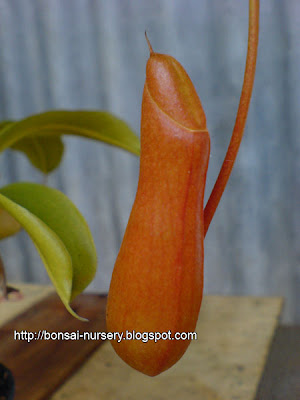
Here list of Nepenthes Hybrids Species There are many hybrid Nepenthes and numerous named cultivars. The following are named natural hybrids:
N. × alisaputrana (N. burbidgeae × N. rajah)
N. × bauensis (N. gracilis × N. northiana)
N. × cantleyi (N. bicalcarata × N. gracilis)
N. × cincta (N. albomarginata × N. northiana)
N. × ferrugineomarginata (N. albomarginata × N. reinwardtiana)
N. × ghazallyana (N. gracilis × N. mirabilis)
N. × harryana (N. edwardsiana × N. villosa)
N. × hookeriana (N. ampullaria × N. rafflesiana)
N. × kinabaluensis (N. rajah × N. villosa)
N. × kuchingensis (N. ampullaria × N. mirabilis)
N. × merrilliata (N. alata × N. merrilliana)
N. × mirabilata (N. alata × N. mirabilis)
N. × pangulubauensis (N. mikei × N. pectinata)
N. × pyriformis (N. inermis × N. talangensis)
N. × sarawakiensis (N. muluensis × N. tentaculata)
N. × trichocarpa (N. ampullaria × N. gracilis)
N. × truncalata (N. alata × N. truncata)
N. × trusmadiensis (N. lowii × N. macrophylla)
N. × tsangoya ((N. alata × N. merrilliana) × N. mirabilis)
N. × ventrata (N. alata × N. ventricosa)
Some of the more well known artificially produced hybrids include:
N. 'Coccinea' ((N. rafflesiana × N. ampullaria) × N. mirabilis)
N. × emmarene (N. khasiana × N. ventricosa)
N. 'Gentle' (N. fusca × N. maxima)
N. 'Judith Finn' (N. veitchii × N. spathulata)
N. 'Miranda' ((N. maxima × N. northiana) × N. maxima)
N. 'Mixta' (N. northiana × N. maxima)
N. 'Ventrata' (N. ventricosa × N. alata)
For more information about Nepenthes ( Kantung Semar ), visit http://en.wikipedia.org/wiki/Nepenthes
List of Nepenthes species :
( Kantung Semar )
Nepenthes adnata
Nepenthes adrianii
Nepenthes alata
Nepenthes albomarginata
Nepenthes ampullaria
Nepenthes anamensis
Nepenthes angasanensis
Nepenthes argentii
Nepenthes aristolochioides
Nepenthes beccariana
Nepenthes bellii
Nepenthes benstonei
Nepenthes bicalcarata
Nepenthes bongso
Nepenthes boschiana
Nepenthes burbidgeae
Nepenthes burkei
Nepenthes campanulata
Nepenthes carunculata
Nepenthes chaniana
Nepenthes clipeata
Nepenthes copelandii
Nepenthes danseri
Nepenthes deaniana
Nepenthes densiflora
Nepenthes diatas
Nepenthes distillatoria
Nepenthes dubia
Nepenthes edwardsiana
Nepenthes ephippiata
Nepenthes eustachya
Nepenthes eymae
Nepenthes faizaliana
Nepenthes fusca
Nepenthes glabrata
Nepenthes glandulifera
Nepenthes globosa
Nepenthes gracilis
Nepenthes gracillima
Nepenthes gymnamphora
Nepenthes hamata
Nepenthes hirsuta
Nepenthes hispida
Nepenthes hurrelliana
Nepenthes inermis
Nepenthes insignis
Nepenthes izumiae
Nepenthes jacquelineae
Nepenthes jamban
Nepenthes junghuhnii
Nepenthes khasiana
Nepenthes klossii
Nepenthes lamii
Nepenthes lavicola
Nepenthes lingulata
Nepenthes longifolia
Nepenthes lowii
Nepenthes macfarlanei
Nepenthes macrophylla
Nepenthes macrovulgaris
Nepenthes madagascariensis
Nepenthes mapuluensis
Nepenthes masoalensis
Nepenthes maxima
Nepenthes merrilliana
Nepenthes mikei
Nepenthes mindanaoensis
Nepenthes mira
Nepenthes mirabilis
Nepenthes mollis
Nepenthes muluensis
Nepenthes murudensis
Nepenthes naquiyuddinii
Nepenthes neoguineensis
Nepenthes northiana
Nepenthes ovata
Nepenthes paniculata
Nepenthes papuana
Nepenthes pectinata
Nepenthes pervillei
Nepenthes petiolata
Nepenthes philippinensis
Nepenthes pilosa
Nepenthes platychila
Nepenthes rafflesiana
Nepenthes rajah
Nepenthes ramispina
Nepenthes reinwardtiana
Nepenthes rhombicaulis
Nepenthes rigidifolia
Nepenthes rowanae
Nepenthes sanguinea
Nepenthes saranganiensis
Nepenthes sibuyanensis
Nepenthes singalana
Nepenthes smilesii
Nepenthes spathulata
Nepenthes spectabilis
Nepenthes stenophylla
Nepenthes sumatrana
Nepenthes talangensis
Nepenthes tenax
Nepenthes tentaculata
Nepenthes tenuis
Nepenthes thorelii
Nepenthes tobaica
Nepenthes tomoriana
Nepenthes treubiana
Nepenthes truncata
Nepenthes veitchii
Nepenthes ventricosa
Nepenthes vieillardii
Nepenthes villosa
Nepenthes vogelii
Nepenthes xiphioides
Nepenthes zakriana
Taken From Wikipedia, the free encyclopedia
 Nepenthes (Indonesian name : Kantung Semar )
Nepenthes can also refer to Nepenthe, a drug of forgetfulness mentioned in Greek mythology.
The Nepenthes (IPA pronunciation: /nə.pɛnˈθiz/, from Greek: ne = not, penthos = grief, sorrow; named after the ancient drug Nepenthe), popularly known as Tropical Pitcher Plants or Monkey Cups, are a genus of carnivorous plants in the monotypic family Nepenthaceae that comprises roughly 116 species, numerous natural and many cultivated hybrids. They are vine forming plants of the Old World tropics, ranging from South China, Indonesia, Malaysia and the Philippines; westward to Madagascar (2 species) and the Seychelles (1); southward to Australia (3) and New Caledonia (1); and northward to India (1) and Sri Lanka (1). The greatest diversity occurs on Borneo and Sumatra with many endemic species. Many are plants of hot humid lowland areas, but the majority are tropical montane plants, receiving warm days but cool to cold humid nights year round. A few are considered tropical alpine with cool days and nights near freezing. The name 'Monkey Cups' refers to the fact that monkeys have been observed drinking rainwater from these plants.
Morphology and function The plants usually consist of a shallow root system and a prostrate or climbing stem, often several metres long, and usually 1 cm or less in diameter, although this may be thicker in a few species (e.g. N. bicalcarata). From the stems arise leaf-like expanded petioles, similar to certain Citrus spp., ending in a tendril, which in some species aid in climbing, and at the end of which forms the pitcher, considered the true leaf. The pitcher starts as a small bud and gradually expands to form a globe- or tube-shaped trap.
Basic structure of an upper pitcher
The trap contains a fluid of the plant's own production, which may be watery or syrupy and is used to drown the prey. The lower part of the trap contains glands which absorb nutrients from captured prey. For detailed information on the digestion process, see the External Links section. Along the upper inside part of the trap is a slick waxy coating which makes the escape of its prey nearly impossible. Surrounding the entrance to the trap is a structure called the peristome (the "lip") which is slippery and often quite colorful, attracting prey but offering an unsure footing. Above the peristome is a lid (the operculum): in many species this keeps rain from diluting the fluid within the pitcher, the underside of which may contain nectar glands which attract prey.
Nepenthes usually produce two different types of pitchers. Appearing near the base of the plant are the large lower traps, which typically sit on the ground, while the upper pitchers may be smaller, colored differently, and have different features than the lower pitchers. These upper pitchers usually form as the plant reaches maturity and the plant grows taller. To keep the plant steady, the upper pitchers form a loop in the tendril, allowing it to wrap around nearby support. In some species (e.g. N. rafflesiana) different prey may be attracted by different types of pitchers.
Prey usually consists of insects, but the largest species (N. rajah, N. merrilliana, etc.) may occasionally catch small vertebrates, such as rats and lizards. Flowers occur in racemes or more rarely in panicles with male and female flowers on separate plants. Seed is produced in a four-sided capsule which may contain 10-60 or more seeds, consisting of a central ovary and two wings, one on either side. Seeds are wind distributed.
Cultivation
Nepenthes may be cultivated in greenhouses. Easier species include N. alata, N. ventricosa, N. khasiana, and N. sanguinea. These four species are highlanders (N. alata has both lowland and highland forms), some easy lowlander species are N. rafflesiana, N.bicalcarata, N.mirabilis, and N.hirsuta.
"Highlander" forms are those species that grow in habitats that are generally higher up in elevation, and thus exposed to cooler evening temperatures. "Lowlander" forms are those species that grow nearer to sealevel.
Both forms respond best to rainwater (but tap water works as long as you flush it out with rainwater every month), bright light (not full sun), a well drained but moisture holding medium, good air circulation and a relatively high humidity. Highland species must have night-time cooling to thrive in the long-term. Chemical fertilisers are probably best avoided or used at low strength. Occasional feeding with frozen (thawed before use) crickets may be beneficial. Terrarium culture of smaller plants like N. bellii, N. × trichocarpa and N. ampullaria is possible, but most plants will get too large over time.
Plants can be propagated by seed, cuttings, and tissue culture. Seeds may be sown on damp chopped Sphagnum moss, or on sterile plant tissue culture media once they have been properly disinfected. The seeds generally become inviable soon after harvesting, so seed are not usually the preferred method of propagation. A 50:50 mixture of orchid medium with moss or perlite is suitable for germination and culture. Seed may take two months to germinate, and two years or more to yield mature plants. Cuttings may be rooted in damp Sphagnum moss in a plastic bag or tank with high humidity and moderate light. They can begin to root in 1-2 months and start to form pitchers in about six months.
Tissue culture is now used commercially and helps reduce collection of wild plants, as well as making many rare species available to hobbyists at reasonable prices. Nepenthes are considered threatened or endangered plants and are listed in CITES appendices 1 & 2.
Taken From Wikipedia, the free encyclopedia
Nepenthes





